Down the OBB Rabbit Hole: Pragmatic Strategies and Innovation Plays for Rural Hospitals
I kept hearing “OBBBA will crush (rural) hospitals so I started digging in to understand. Then I thought I'd write a quick paragraph on it, ended up with ChatGPT (o3) as my tireless intern. The result: a pocket guide to what actually hits, when, and how big the bruise will be. If anything’s off, blame OpenAI (or my prompts) — then tell me so we all learn.
Five policy levers & when they bite
- 2025 - Dec 31 2025 - State Applications for Rural Health Funds DUE (or earlier as per CMS discretion). THIS IS THE LAST DATE, APPROVALS CAN COME BY OCT 31 2025
- 2026 (effective Jan 1) → Coverage churn: 80-hour Medicaid work rule kicks in ⇒ more uninsured ED visits / bad debt.
- 2026-2030: $10 B tranche of the Rural Health Transformation Fund—state must have applied by 12/31/2025.
- 2027 → Revenue shave #1: first 10 % haircut on existing State-Directed Payments (SDPs).
- 2029-32 → More cuts: delayed $8 B/yr DSH reductions (urban/safety-net) and annual provider-tax step-downs to 3.5 % (this seems like it always gets pushed back and may never happen, Congress has postponed these cuts five times already)
NOTE: A quick reality-check for urban and suburban safety-net systems: the Rural Health Transformation Fund won’t reach you. Your timeline is the same coverage churn in ’26 and the same SDP/provider-tax cuts in ’27-’28—but without a dedicated grant cushion.
What the cuts look like in one “average” rural hospital
Consider a 50-bed, non-critical-access hospital in a typical mixed-payer state. It runs about 50 percent Medicare, 20 percent Medicaid, and barely breaks even today. The table puts real dollars around the OBB timeline:
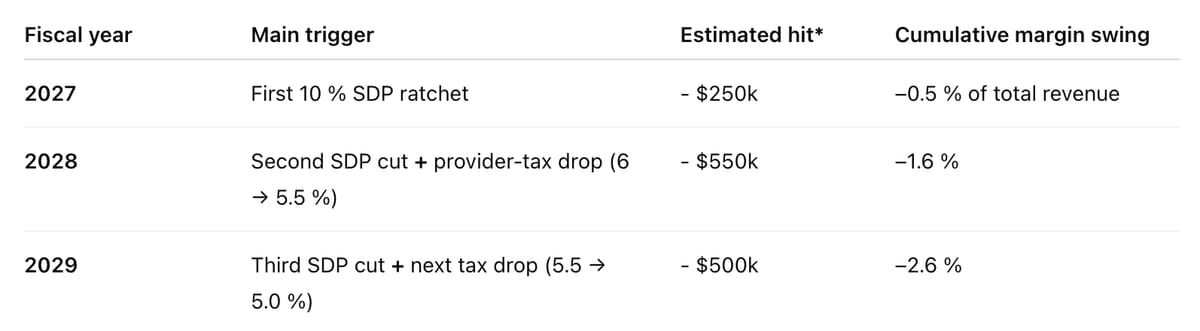
For a hospital whose operating margin hovers between –3 % and +1 %, a three-year $1.3 million squeeze is the difference between “sticky red ink” and the ability to refinance a line of credit. (At 1 % operating margin on $50 M revenue, $500 K cancels an entire year’s profit). That math plays out hundreds of times over across rural America.
Hospital-level actions before the wave hits
We will discuss substantive AI and innovation drivers to potentially help(ie why I started down this path), but first a couple of adjacent areas that still indirectly relate to your AI and technology strategy)
URGENT - Align with the Rural Health Transformation Fund (RHTF) now A state’s grant application locks in by December 31 2025. If your virtual _____ bundle or facility-refresh plan isn’t in that packet, you will miss out entirely. Also innovation established now creates a track record for evidence that could strengthen your call for more support for building out your initiatives.
- Money can flow as early as October 2025 (first day of FY 2026) once CMS approvals are issued.
- Funds must be put to work quickly: every dollar is on a two-year shot clock, and CMS will start clawing back idle balances in March 2028.
Make Medicaid paperwork painless Every uninsured ED visit costs more than software bots that nudge patients to upload a pay stub. If bad debt >2 % of revenue, a lean outreach workflow usually pays back inside twelve months. It seems crazy, but its clearly in hospitals and their supporters interests to help make sure your current and potential patients dont lose benefits or slip in an out of the program due to paperwork.
Bring philanthropy forward and focus it. Local donors are far likelier to fund a tele-observation bay than abstract “operations.”
Where innovation has to step up—risk first, upside later
Policy tweaks feel like lawyer chess; the real oxygen is productivity. AI finally lets us talk about order of magnitude improvements to certain operations. No technology disruption before, not the internet, cloud, social or mobile had that kind of potential for hospitals. Vendors—including LookDeep Health —should shoulder some risk.
- Lower subscription before RTHF arrive in 2025-26, when cash is tight; be billing to take risk with the Rural Hospital on if they are approved (at risk until approval)
- Create at risk arrangements that payoff if you deliver - both hospitals and vendors need this kind of alignment
If your tech does what the ROI analysis claims, both sides win and the relationship cements. If it doesn’t, the hospital keeps the savings it managed to bank. That’s fair—and long overdue in health-tech sales.
Closing thought: real productivity or bust
The U.S. hospital engine has never lacked heart; it has lacked leverage. Neither the internet, the cloud, mobile, nor social media could bend cost-per-patient in ways rural CFOs could see on a P&L. AI can—and must. Whatever you believe about the wisdom of OBB, the need to scale care with fewer hands is not going away, it is the real first principles problem.
Bigger minds can wrestle the politics; operators and innovators have the more urgent job: turn algorithms into bedside hours saved and patient days made safer. That work starts before the next budget cycle, not after and must move faster and more iteratively. Never waste a crisis, necessity is the mother of invention, burn the ships - pick your favorite one and live it. Its time for AI to cross over the BS echo chambers and deliver for hospitals in the core of what they do - effectively caring for patients efficiently.